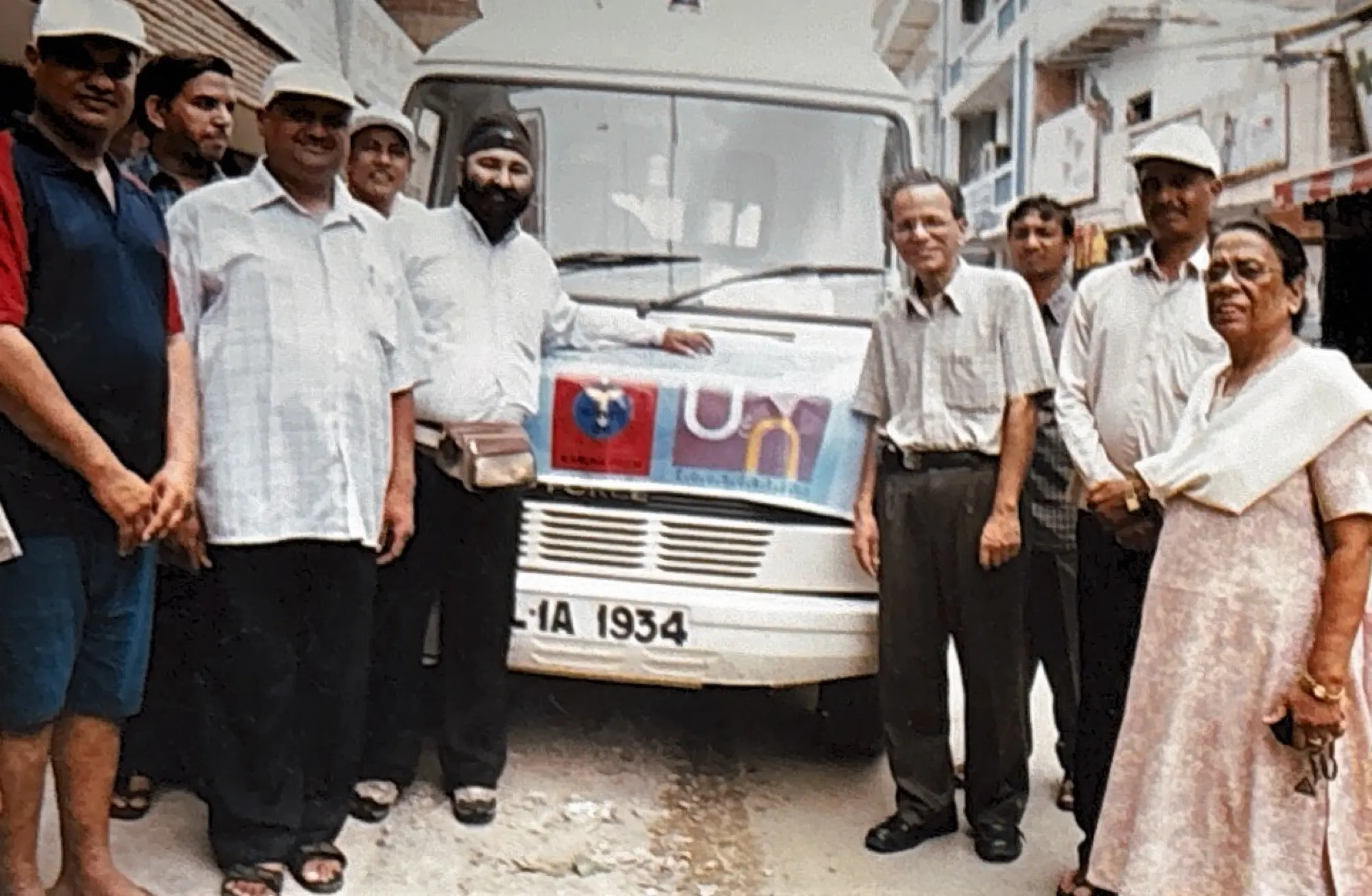
Nathu works at a dam construction site. Arthritis made every shift harder, but a clinic visit meant lost wages, travel and fees he could not cover. What changed his situation was a van that arrived where he already was, with a doctor, an X-ray and medicines at no charge.
That van is part of Project Health-On-Wheels, run by the U & N Foundation (UNF) with Karuna Prem. It is one way to answer a plain question: if people cannot get to healthcare, how does healthcare get to them? This post explains how mobile health camps in India work, what separates a useful one from a photo opportunity, and what UNF's programmes look like on the ground.
Why camps exist: distance, cost and silence
Health camps are not a substitute for a functioning public health system. They fill gaps. Three gaps come up again and again.
- Distance. In a written reply to Parliament on cataract care, the Ministry of Health listed lack of awareness in remote areas and limited access to treatment facilities in remote areas among the reasons for India's cataract burden (2022).
- Cost. A consultation is cheap next to the day's wage a labourer loses by going to get it.
- Silence. Many conditions give no alarm. The National Family Health Survey for 2019-21 found that 57.0% of women aged 15-49 in India were anaemic, along with 67.1% of children aged 6-59 months. Anaemia often goes unnoticed until someone tests for it.
A camp deals with all three at once: it travels, it charges nothing or very little, and it screens people who did not know to ask.
Four formats, and what each is good for
UNF's healthcare projects with Karuna Prem show that "health camp" covers several different things.
The mobile clinic: Health-On-Wheels
Project Health-On-Wheels deploys mobile units staffed with medical professionals, diagnostic equipment and essential medicines in underserved areas of Delhi and adjoining Haryana. Services include free consultations, diagnosis and treatment advice, free medicines, and health education on nutrition, hygiene and disease management. The format suits repeat visits to the same communities.
The mini camp: short, frequent, dental-heavy
The Mini Healthcare Programme runs two-day camps staffed by doctors, dentists and paramedics. UNF reports outpatient care for 500 to 800 patients a day, with dental examinations, cleanings and extractions as a priority. Camps are held monthly or every two months in the same places, and the project page names locations including Dehradun, Mussoorie, Harsil and Gangotri. Regular return visits are the point: one camp finds a problem, the next one checks whether it is improving.
The mega camp: a field hospital for a week
The Mega Healthcare Programme is the heavy end. Two camps a year, each lasting five to six days, for roughly 7,000 to 15,000 patients, set up in schools, temples or existing dispensaries in remote areas lacking government or private facilities. Specialities include general medicine, general surgery, orthopaedics, obstetrics and gynaecology, ophthalmology, ENT, dental and physiotherapy. On-site pathology tests, X-rays and ultrasound mean diagnosis does not wait for a referral, and indoor beds handle post-operative and short-term care. It also covers hearing aids, dentures and glasses.
The condition-specific camp: cataracts and school eye checks
Cataract is the single biggest cause of blindness among people over 50 in India. The government's National Blindness and Visual Impairment Survey (2015-19) attributed 66.2% of blindness in that age group to cataract, and found most blindness avoidable. UNF's New Vision programme offers cataract consultations and intraocular lens implant surgery for underprivileged patients at no cost or on a highly subsidised basis. Eye-Right serves visually impaired students at the AICB school with examinations, corrective lenses, referrals and eye-health education.
What it looks like for one patient
The programme pages describe services. The success stories show what they feel like.
An arthritis patient who could finally get treated. Nathu's account in Relief on Wheels says the project "instilled a sense of dignity and empowerment, reminding him that his health mattered and that he deserved access to quality healthcare, regardless of his financial circumstances."
A cough that turned out to be tuberculosis. At a camp offering dental and ENT checkups, a woman named Meera was noticed by the health professionals because of a persistent cough. UNF's story, Healing Hearts, Healing Lungs, says she had TB that "had gone untreated for far too long", and that she received a treatment plan and a supply of medicines. She was at a camp offering dental and ENT checkups and left with a diagnosis she had not come for. That is the strongest argument for general camps over single-issue ones.
A warning sign caught early. In Journey of Awareness, Ravi attends a camp session on mouth cancer, notices early warning signs he "might have otherwise dismissed" and seeks help in time for an early diagnosis.
A grandmother who could see her family again. In New Vision Camp: A Grandma's Tale of Renewed Vision, a grandson in Madhya Pradesh watches free cataract surgery lift "the fog that had obscured her eyes."
Beyond the camp: care that continues
Two UNF projects cover what a camp cannot. Swasthya Seva supports treatment for poor patients at Patliputra Nursing Home in Samaypur, Delhi, and supplies clinic injectables and consumables. The Lifeline Wheels Project, with Shri Shani Dham Trust, provides a trauma vehicle with a multiparameter patient monitor for emergency transport. UNF's story for it, Wheels of Hope, reports that the vehicle has saved the lives of hundreds of people with serious injuries. That figure is UNF's own report.
What makes a health camp worth running
These are our observations, not UNF claims. A camp that helps tends to have:
- A return date. A one-off camp can find disease but cannot manage it. Treatment for TB, for example, takes months.
- Medicines and diagnostics on site. A prescription for a drug the patient cannot buy is half a service.
- A referral path. Mega camps handle surgery, but a patient who needs a specialist later must know where to go.
- Local organisers. UNF's mini camps rely on local organising committees. People turn up when someone they know has told them to.
- Education built in. Blood pressure checks, sugar tests and talks on tobacco, alcohol and family planning are part of the Mega camp design.
What a camp cannot do
It is worth being straight about the limits. A camp cannot replace a hospital that is open every day, and a week of free surgery does not fix a village without a nurse. Patients with chronic conditions such as diabetes, high blood pressure or TB need follow-up that no travelling team can promise alone. The honest measure of a camp is not how many people queued, but how many of them got a diagnosis, a treatment plan and a way to carry it through.
UNF's own pages are mostly about services delivered, with patient numbers reported per camp rather than health outcomes tracked over years. If you are a donor or partner weighing up camp programmes, ask for both: how many people were seen, and what happened to them afterwards.
How to attend, support or volunteer
UNF's site does not publish camp dates, so ask the team for current schedules and locations. For questions, use the contact page (Saket, New Delhi; Monday to Saturday, 10 am to 7 pm). If you are a doctor, dentist, nurse or logistics person, the volunteer page says UNF welcomes people who can offer medical expertise.
Frequently asked questions
What is a mobile health camp?
A mobile health camp brings doctors, diagnostic equipment and medicines to a community instead of asking people to travel to a clinic. Formats range from a van that visits regularly to week-long camps set up in schools or temples.
Are UNF's health camps free?
UNF's Health-On-Wheels project provides free consultations and free medicines. The New Vision cataract programme offers care at no cost or at highly subsidised rates. Check with the organisers for the terms of a specific camp.
Where does UNF run health camps?
Health-On-Wheels serves underserved areas in Delhi and adjoining Haryana. The Mini Healthcare Programme names locations such as Dehradun, Mussoorie, Harsil and Gangotri. UNF runs these with its partner Karuna Prem.
What conditions can a health camp screen for?
UNF's Mega Healthcare Programme lists general medicine, surgery, orthopaedics, gynaecology, eye, ENT and dental care, with on-site lab tests, X-rays and ultrasound. UNF's success stories describe camps catching tuberculosis and early-stage mouth cancer.
Can I volunteer at a health camp?
UNF's volunteer page invites people to offer skills such as medical expertise. Email info@unf.in with your skills and availability.
Sources
Be part of the work
Volunteer, partner or support a project with U & N Foundation.